
Between Light and Intellect
Ṣadrā's Ontology of the Qur’an and the Heart

Note to the Reader
After publishing my series of notes on Islamic psychology, a good friend introduced me to the work of Mulla Sadra. That encounter inspired me to dig deeper. The journey continues.
It is always a privilege to discover that one's innate understanding aligns with the insights of those we regard as the greats. Honor their legacy, and honor the knowledge within you.
Enter the Light
In the Name of the All-Knowing, the All-Wise
My engineering background trained me to see the world as interconnected systems, structures and dynamic processes continuously evolving. After learning more about the Qur’an it does not require such a lens for its truths to be unveiled; it is self-evident. Allow me to explain. The language of the Quran, in itself, is a poetically engineered system of divine disclosure where ontology, psycho-sociology, ethics, and the unseen converge. It is not a book of doctrine alone, but a blueprint for the Real, every verse layered with meaning, every letter placed with cosmic precision. Some assume that reading the Qur’an through the lens of systems is a projection of my own training.
But I believe it is recognition, not projection. And today, I am not alone in this.
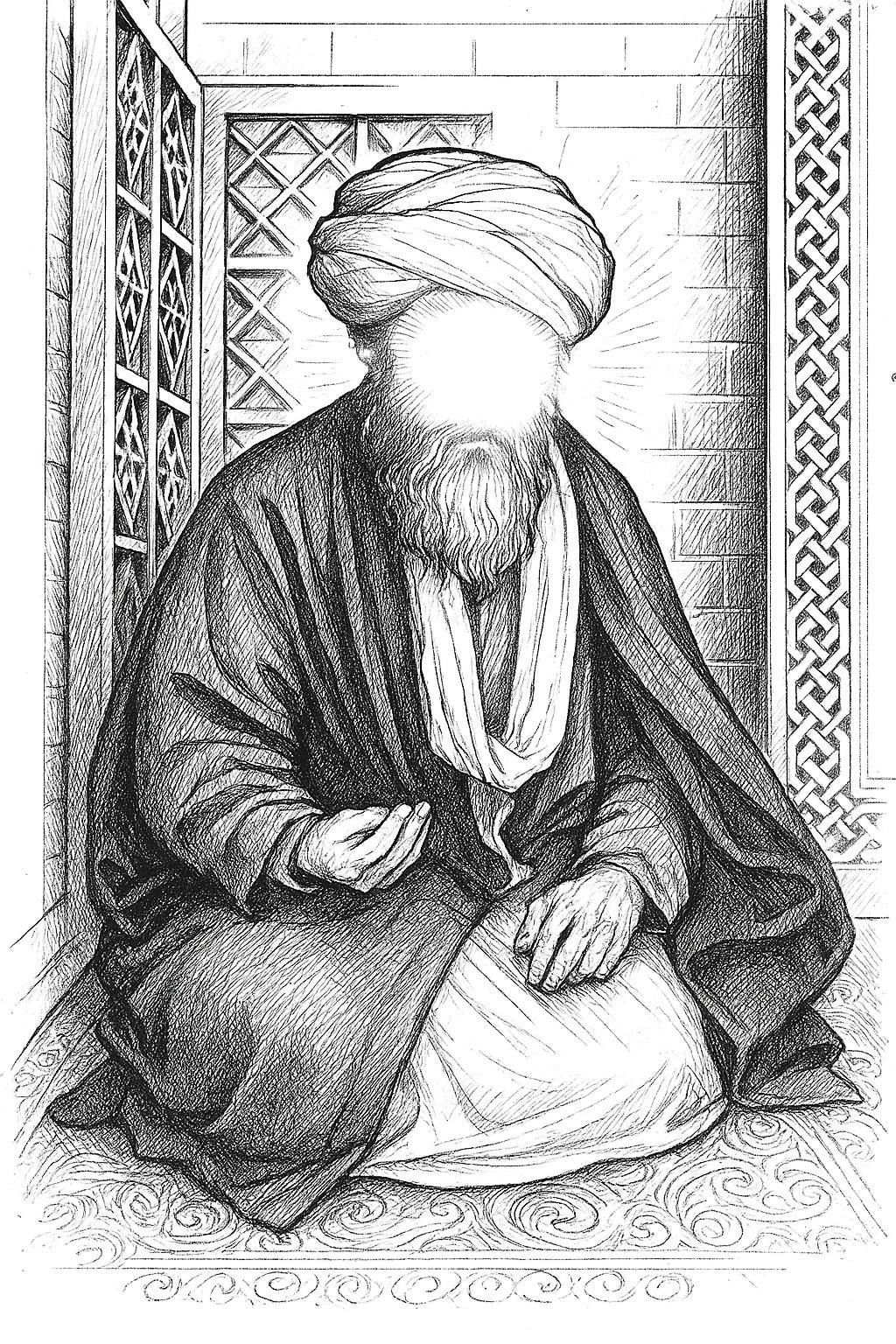
Centuries ago, Ṣadr al-Dīn al-Shīrāzī, better known as Mulla Ṣadrā, saw through the same lens, though his was polished by divine unveiling. He did not read the Qur’an as a scholar trying to explain it; he entered it as one who lived its unfolding. At the heart of Ṣadrā’s vision is the idea that existence (wujūd) is not a category or a concept, it is the only reality. Everything that appears, forms, names, selves, is a degree of existence, like rays from a single sun. Existence is not uniform; it flows, it intensifies, it dims, it reflects. From God, the Creator, emanates all that is, each thing in proportion to its capacity to receive. To read the Qur’an in this light is to see it not as a linear book, but as a topology of existence, descending from the Absolute and returning back through its layers of expression.
"He is the First and the Last, the Manifest and the Hidden..." (Qur’an 57:3)
A World Built on Wujūd
At the center of Mulla Ṣadrā’s philosophy is one monumental assertion: Being (wujūd) is the sole, undivided, and foundational reality. Everything else such as form, matter, essence, multiplicity is derivative. We don’t live in a world of things, we live in a continuum of being, from the dense and dark to the subtle and luminous. All things are degrees of wujūd — layers in the unfolding of Divine Presence.
The Qur’an reflects this vision again and again.
Consider:
"Allah is the Light of the heavens and the earth..." (Qur’an 24:35)
"Everything will perish except His face..." (Qur’an 28:88)
Ṣadrā did not read these verses as metaphors. For him, they described the very ontology of existence. Nothing possesses independent reality. Things appear separate, but they are ultimately contingent ripples in the ocean of God's Being.
This is the beginning of sacred philosophy: to realize that what is most real is not the object in front of you, but the light by which you perceive it, and that light itself is a trace of the Real.
For centuries, Islamic philosophy leaned heavily on Aristotle’s idea that change occurs only in accidents, attributes like size, shape, or color. But Mulla Ṣadrā challenged this. He argued that substance itself is in motion. Everything, including the human soul, is in a state of continual transformation.
He called this principle al-ḥaraka al-jawhariyya, substantial motion. You are not the same self you were a moment ago. You are continually unfolding. Becoming. Shedding and acquiring layers of being. Your essence is not static; it is journeying toward its own fulfillment.
The Qur’an affirms this dynamic model of the self:
"You will surely journey from stage to stage." (Qur’an 84:19)
"O soul at peace, return to your Lord, well-pleased and pleasing..." (Qur’an 89:27–28)
Mulla Ṣadrā saw the soul as a seed, not born fully formed, but developing through a cosmic curriculum. It begins in materiality, evolves through sensation and imagination, and finally awakens to pure intellect and the presence of the Divine.
Knowledge Is Presence, Not Representation
In the modern world, we are trained to think that knowledge is something we possess. We accumulate it, analyze it, store it in memory. But Ṣadrā redefined knowledge at its root: real knowledge is not about holding a concept, it is about being present with reality. This is what he called al-‘ilm al-ḥuḍūrī; knowledge by presence. It is direct, unmediated, experiential. You do not “know” pain, you are present with it. You do not “know” God in the abstract, you stand before the Real in unveiled awareness.
This aligns perfectly with how the Qur’an speaks about the heart and knowledge:
"It is not the eyes that are blind, but the hearts within the chests that are blind." (Qur’an 22:46)
This form of knowledge transcends mental categories. It is intimate, like fire touching the skin. It’s why the Qur’an was not revealed to the Prophet ﷺ as a set of doctrines to be analyzed, but as a light to be absorbed. As knowledge to be meditated on and metabolized into being.
The Healing Axis: Body, Qalb, and Cosmos
Ṣadrā viewed the human being as a microcosm of the universe. The structure of your soul reflects the architecture of the cosmos. Healing, in this vision, is not merely physical or mental, it is ontological. Illness is disconnection from your rightful mode of being. Healing is returning to the divine trajectory inscribed in your soul. The heart, Al-Qalb, plays a central role. It is not merely the seat of emotions. It is the organ of vision, presence, and divine reception.
“There is a piece of flesh in the body—if it is sound, the whole body is sound… It is the heart.” (Ṣaḥīḥ al-Bukhārī)
As I have mentioned in my previous notes, the heart can be hardened, veiled, darkened. But it can also be cleansed, awakened, and illuminated. The Qur’an is not only guidance, it is shifāʾ, healing. Not just for the mind or the body, but for the subtle core of your being.
The Qur’an as Ontological Map
Mulla Ṣadrā approached the Qur’an not just as a legal or moral text, but as a multi-layered ontological system. Each verse, each word, carries meaning on levels that correspond to the different planes of existence. Literal meaning, symbolic meaning, ontological meaning, all coexist.
The Qur’an does not describe reality; it discloses to those who have the hearts to see.
"Do they not reflect upon the Qur’an, or are there locks upon their hearts?" (Qur’an 47:24)
For Ṣadrā, ta’wīl, esoteric interpretation, was not about abstraction, but about “descent” into the layers of Being. To interpret the Qur’an was to move from surface to depth, from image to light, from sign to presence.
The Arabic language itself, he believed, was transformed by the Qur’an. It became not just a language of communication, but a vessel of divine unveiling. One grammatical shift, one vowel, could change the entire ontological trajectory of a verse.
And perhaps that's why Arabic is one of the rare languages that activates both hemispheres of the brain, as though it was made to unify dualities.
Living the Ascent
To walk with Ṣadrā is not to become a philosopher. It is to become more awake to the structure of your own being. To align with the motion of your own soul. To see that you are not a static creature waiting to be judged, you are a being in becoming, a soul in motion, a reflection of the Real.
The Qur’an speaks in unfolding systems because it speaks from the Real. It does not only tell you what to believe, it reveals what is as it is.
"Indeed, to your Lord is the return." (Qur’an 96:8)
The return is not to a location, but to a level of being.
To a clarity.
A nearness.
In that nearness, the heart sees.
Remarkable mashAllah. JazakAllah as always for your efforts and wisdom! I just so happened to be listening to a lecture about Mulla Sadra right before seeing this 😂 So insightful!
Beautiful ❤️